|
|
|
The
anniversary cake made evident what everyone knew:
that twenty five years is a long time for a show
to run, and that the Puget Sound Toy Show at the
Northwest Washington Fair Grounds in Lynden WA was
a stalwart survivor, one of the last of the roster
of a half dozen Northwest toy shows. Most shows
now specialize, as did this one in Farm Toys, a
natural fit for a small town surrounded by rolling
farmland.
At
any show sellers display their wares, but this one
also invites collectors to show their collections,
and “Not for Sale” signs are just as common as
one’s marked “Bargain” and “Rare”. Some of the
most fascinating are dioramas of farms and towns,
some anticipating the annual Toy Train Show held
the next weekend. One of the most fascinating
dioramas had plowed fields made of combed coffee
grounds.
Being
a robot collector, I came to walk the tables of
Oliver and John Deere tractors, and get ideas from
the dioramas of scale muscle cars. But I did close
the sale on an Erector Set from the early ‘50s,
that had seen better days and had pieces missing,
but qualified both as “rare” and “bargain”.
Glancing across the room, however, I saw a
towering construction that looked as if someone
had started playing with an Erector set and just
kept building. Having secured my own set in the
car trunk I ran over and met the owner, Gareth
Kundert, and begged to see the contraption in
action. Once he turned it on, it was the hit of
the show, a magnet for wide-eyed kids and
attendant adults. I snapped a few pics, and
Gareth, in true collector spirit, consented to
conduct a phone interview the next day about:
Gareth
Kundert's
Marvelous Machine
|
|
|
GW:
Looking at your device brings back memories of Erector
and Meccano sets, because it looks like someone
started building and made an outstanding model.
GK:
Considering
it was made it 1945, it was mostly hand made. I have a
lot of admiration for the man who was able to make it.
His name was “L.E. Dierks”. It’s etched on the brass
where the controls sit. That’s the most history I have
on the builder.
GW:
“The
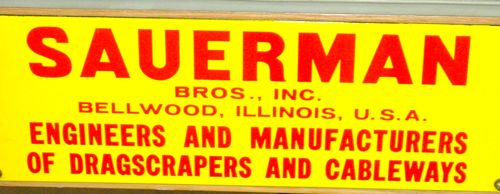
plaque on the model says that Sauerman Bros.
manufactured “Dragscrapers and Cableways”. Is that
what this is?
GK:
It’s
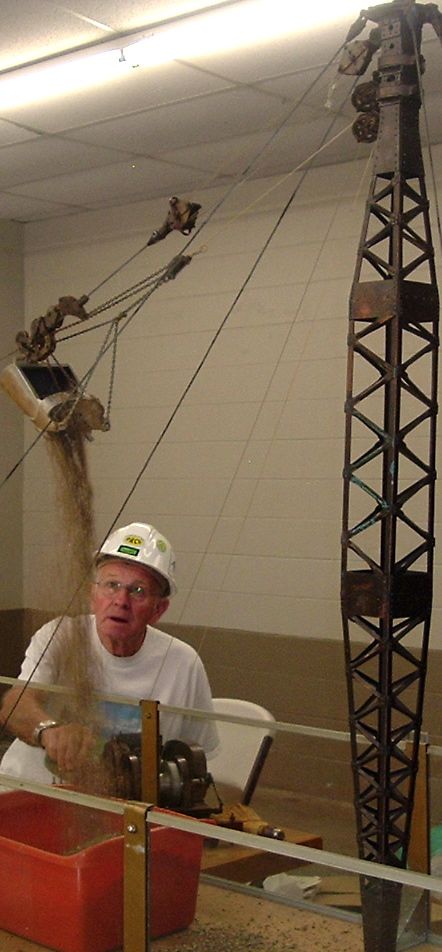
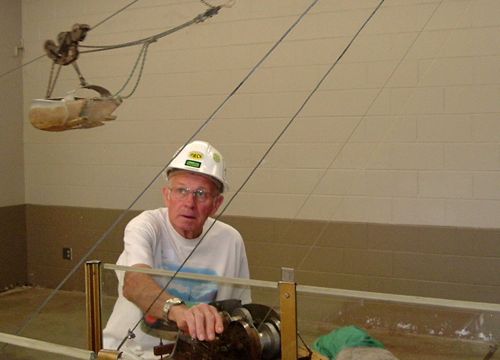
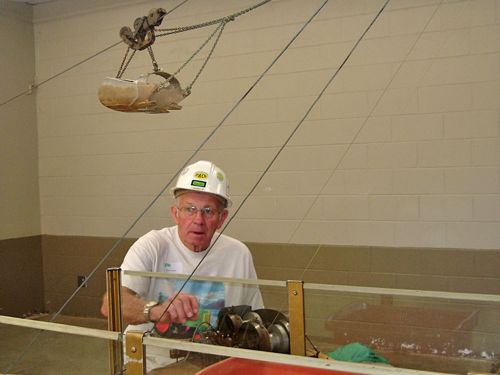
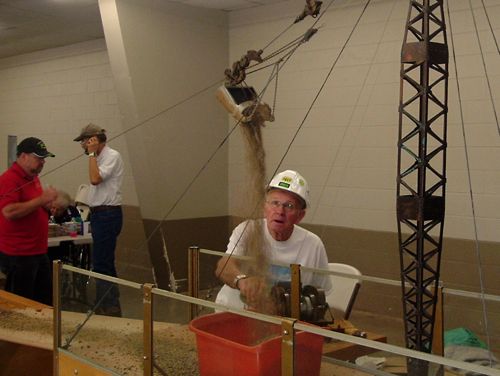
a working demonstration model of a dragscraper, which
was used to promote the product. The model was made in
1945, but they’ve been in business a lot longer than
that.
GW:
Your
model towers about eight feet high, if you include the
table, and spans about twenty feet. Do you think it’s
to scale?
GK:
Yes,
but I’m not sure what scale they used. This might
represent about a five yard bucket. These things were
made according to the job site. If you had a small
area, it would be a short tower. If you had a larger
area, a taller tower. The height of the tower was
determined by the length of the run.
GW:
When
did the model come into your possession?
GK:
In
1989. I worked for Pacific American Commercial in
Seattle, and my boss got it on loan from Sauerman in
1982.
|
|
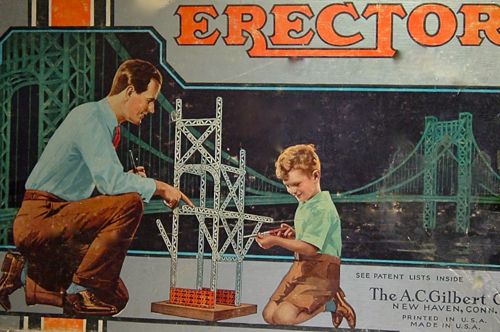
Above: An Erector set from the '50s.
|
|
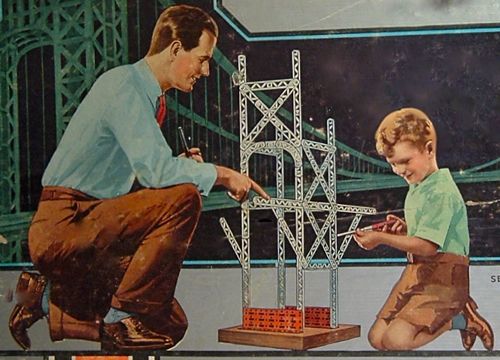
Above: Cover Detail.
|
|
Below: Plaque from the model base.
GW: And you’ve been taking it around to toy shows ever
since?
GK:
Yes.
My boss was a distributor for Saurman, and he got it
on loan from them to help promote the product out
here, and show potential customers how it worked. In
1989, they ran out of room for it, and Saurman didn’t
want it back, because their system is a bit different
now. So they asked me if I wanted to start taking it
around to toy shows. that’s how I got involved doing
what I’m doing.
GW:
Are
the controls on the model similar to the real thing?
GK:
Yes,
they are. The levers would be approximately where
they’re at on the model. It’s running on a sewing
machine motor, which represents a transformer, which
is what the real thing would have if it were electric.
It used to be a three speed motor, and now, due to
wear and tear, is down to one speed. The only thing
that would be different from the model would be the
brakes, because you’d be standing on a platform with
the levers in front of you, and the brakes at your
feet. The model is very detailed, very close to what
the real thing would be.
GW:
You
said, “if it were electric”.
GK:
Yes.
I talked to a gentleman who, in 1929, helped trench a
pond with what they call a donkey system They used
horses on the whole back end slack line. It’s the same
system that’s used in the logging industry, only
instead of a tower, they call it a “spar pole”. They
also used steam power before the turn of the century.
When electrical power came on the scene, they used
that. Plus diesel and gas engines. So there are
multiple ways to power these systems.
GW:
It
looks like when the bucket gets up to a certain point,
it automatically starts turning over to dump out the
load.
GK:
The
line that holds the bucket back is called the slack
line. The one that pulls the bucket up is called the
haul line. There’s a stopblock on the slack line. It’s
kind of hard to describe, but pulling the way it does
causes the chains to pull on the back of the bucket
and tip it over.
GW:
Are
systems like this still in operation?
GK:
Yes.
The company is still in business today. But they didn’t
want the model back, because instead of a built-in
system like this model, today it would have collapsible
hydraulic towers, and be on tracks so it could move
around. It’s much easier. Systems like this are still in
use, but the company is no longer selling this type of
system. But it’s still used in the Northwest, for
instance, by Sterling Breen in Centralia, WA and Cadman
Rock in Monroe, WA, to name a couple examples.
|
|
GW:
May I ask about your own involvement? What made you
want to take this model around? It seems like quite a
bit of work to take around and set it all up and
everything.
GK:
I
enjoy seeing the faces of the little kids when they
see it run, and it’s also a joy to watch the faces of
the big kids.
GW:
It
certainly generated interest this weekend. Do you find
that to be true a lot of places?
GK:
Yes,
it generates a lot of interest because of the fact
that it’s not static; it’s a working model.
GW:
Looking
at the rest of the show, there were quite a few toy
tractors, including some ride-ons, and some very well
kept farm buildings, marked “Happitime”, from the
‘50s, when Marx made all the tin toy buildings.
GK:
That
was my son’s display. Those buildings are all from the
‘50s. Some were sold by Sears and Montgomery Ward.
GW:
That’s
quite a collection. This is an interesting show,
because people have set up dioramas, and aren’t just
selling things.
GK:
Dioramas
are starting to die off, because it’s a lot of work to
do them. But my family all enjoy doing these shows. We
enjoy talking to the people. Sometimes you only see
these friends once a year, but you really enjoy
connecting with them.
GW:
How
did that start? When does that go back to?
GK:
My
sons got involved in 1986. I started getting involved
in 1989, just a little at a time. It just kind of
grew. The Toy Farmer, that’s been in business probably
around thirty years. That magazine was an outgrowth of
people who were collecting already and wanted
something that connected them. The National Farm Show
back in Diresville, Iowa has been going for a long
time. Ertl is back in the Diresville area.
|
|
|
GW:
Are all the toy shows you frequent farm toy type
shows? Where have you taken it?
GK:
Pretty
much farm and construction toy shows. There was one
strictly construction toy show I took it to about
three or four years ago. I’ve had it to Oregon, mainly
Harrisburg. I took it up to the Portland area once. In
Washington state, I’ve had it over to Spokane, down to
Fife and Sumner, and up to Lynden.
GW:
Do
you meet people who’ve used this equipment?
GK:
I’ve
had people who were operating these devices come and
ask me how to make adjustments so they can operate
more efficiently. I get a lot of women coming up and
expressing interest in it, because they ran the
controls for their father. Their dad didn’t have any
sons, so they ended up working with their dad in the
logging industry. Just listening to people’s stories
is a lot of fun.
GW:
There
used to be more toy shows that rotated annually
through the Northwest, which e-Bay and the Internet
have pretty much wiped out.
GK:
Yes.
The Lynden show used to be a lot bigger. It’s true
that e-Bay and the Internet are kind of creating a
problem there. Personally, I like to touch and see
what I’m buying. I like the interaction of the people
I’m dealing with.
GW:
I’d
been to this show before, but I didn’t realize they
had the dioramas on display that weren’t for sale. I
really like that aspect of the show. I’d like to make
a robot diorama.
GK:
My
grandsons and I put up a 1/64 scale diorama of a feed
lot, and put cornmeal in for grain in the feed trough.
There are so many different ways to do these things.
I’ve been to a train show where they take styrofoam
and cut it to shape, and they sculpt it with a propane
torch to look like rocks. You can take green carpet
and make it look like a hay field, and you take Easter
grass and make it look like rows of cut hay. My
daughter had her stamping and scrapbooking stuff at
that show, and if you wanted to bring in your space
stuff and robots, I think a lot of people would be
interested in that.
|
|
GW:
Do you ever sell at shows?
GK:
I’m not one who buys and sells. It’s my biggest
downfall. I’m a collector, and it gets a little tight
crawling around our home. There are people who look
for bargains, just so they can turn around and sell it
again. I don’t get a bargain just to turn around and
make a buck off of it. I just enjoy the collecting. I
look at it this way: a collection doesn’t do you much
good if you’re the only one who looks at it. I enjoy
taking my stuff out where other people can see it and
enjoy it.
GW:
What are your plans now?
GK:
I’m fighting a very aggressive form of sarcoma, which
is a form of cancer, and I’ve lost my arm to it.
Thankfully, I have a lot of family help, which makes
it easier. Otherwise, it would be very difficult for
me to set that model up and take it down, and the same
with my displays. I can do a lot of things, but I
don’t do them as fast as I used to.
GW:
And the sarcoma took your arm?
GK:
It was amputated to keep it from spreading, but
unfortunately, it was already too late.
GW:
You’re certainly out there doing a lot of work.
GK:
I’ve got two choices. I can enjoy life, or I can sit
down and feel sorry for myself. I prefer to do things.
GW:
That’s pretty much the collector spirit. The
stereotype is that collectors passively accumulate
things, but I find collectors taking an interest in
life.
GK:
Some people just accumulate. I like to think of myself
as a collector. I look at it this way. By taking the
model around, I’m preserving history a little bit. I’m
happy people enjoy it. It makes it worthwhile taking
it around.
-Copyright Gord Wilson, 2010.
|
|
|