by
Gord
Wilson (This
article was originally slated for Model Toy and Collector
magazine,
which went
out of print before it could appear).
I
remember the November day in 1963 that a huge box arrived
from a
department store downtown. I was nine years old. The
brown-suited
delivery man set it down in the living room, much to my
mom’s chagrin,
foiling her plan to hide the box away until the holidays.
Christmas
morning confirmed my best hope as I eagerly tore the
wrapping off to
reveal the outlandish, three foot tall, green and gold dream
of every
space-minded kid in 1963: ‘Your Friend From the Moon,” Big
Loo by Marx.
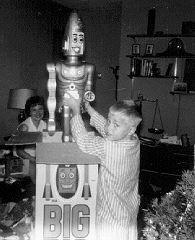
L:
This
isn't me getting Big Loo for
Christmas; it's Paul Reinoehl
from his website. I don't have a picture of me at
that happy moment,
but
Paul has the same expression of happy amazement
that I did. It's the
secret
fraternity of all Big Loo owners. Link to Paul's
site at
spookshows
.com.
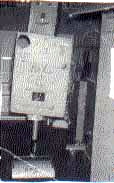
R:
Mac, the first robot I
ever made. Being made of cardboard boxes and
a carpet sweeper, he fell over a lot. His first
upgrade was to wooden
legs on roller skates (one leg is shown in the
background). Then he
didn't fall over as much. |
Big
Loo
dutifully took his place among my line-up of robots and
space toys. Great as he was, I couldn’t say he was my
favorite robot.
But consider the contenders for that title:1961 had brought
Robot
Commando
by Ideal. Although the voice command remote control
malfunctioned the
day after Christmas, he still hurled balls, shot missiles
out of his
head and crawled across the floor with his eyes rolling in
crazy, dizzy
spirals. The big blue robot performed guard duty for Ideal’s
Astro Base
and Deluxe Reading’s Operation X-500 Command Center, both
from 1960,
even
though he was all out of proportion to the red plastic
spaceports.
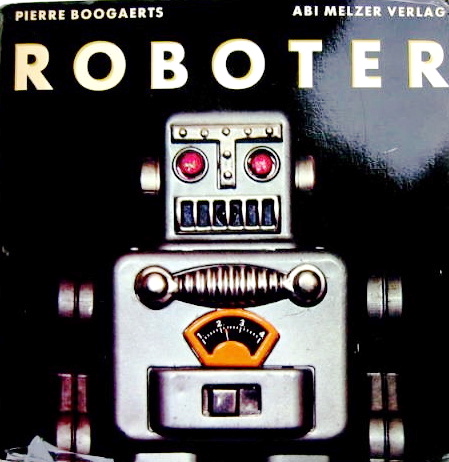
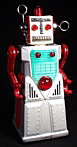
L:
Robot
Commando by Ideal. R: Smoking Spaceman on a
European robot
book. His distinctive barber pole top lamp is not
shown.
|
My
parent’s
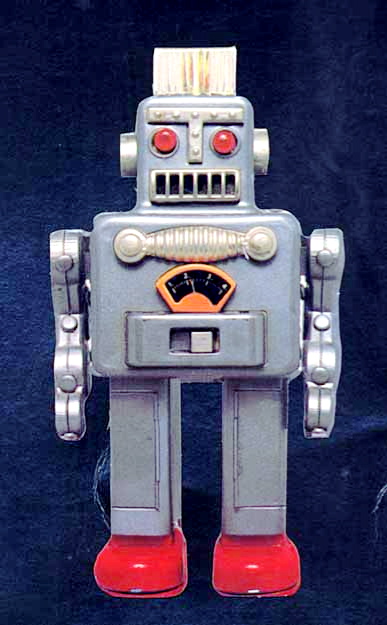
favorite robot was the gray tin Yonezawa/ Linemar Smoking
Spaceman, which from an early age I found unnerving. I’d
shut the
lights off, jump into bed, and watch his eerie red eyes
shining in the
dark,
the spectrum changing on his barber pole top dome, smell the
pungent,
wafting smoke from his mouth grille, hear his mechanical
clanking,
walking
sound. Probably my favorite was the shining white metal
Chief Robot
Man,
if only because my sister gave him to me. He also seemed the
most
robotic.
He’d stop, flash his eyes and top dome while turning his
head with a
metallic, grinding sound, and I never tired of his
mysterious
“bump’n’go” action.
Isaac
Asimov’s
Three Laws of Robotics
Law
One:
A robot may not injure a human being
or through inaction allow a human being to come to
harm.
Law
Two:
A robot must obey the orders given it by
human beings, except where such orders would
conflict with the First
Law.
Law
Three:
A robot must protect its own existence, as
long as such protection does not conflict with the
First or Second Laws.
|
It never
occurred to me to have the robots fight. They shared a
peaceful world with the dinosaurs in my toy box. The
only bruises they
sustained came when a neighbor kid one day declared war
and smashed
them
together. Long before I learned Isaac Asimov’s Three
Laws of Robotics,
however, my robot family had heroic and helpful role
models in Rosey on
The Jetsons and Astroboy, both arriving on TV shortly
before Big Loo.
These
shows were part of the emerging space awareness
engendered after the
Russians
launched Sputnik 1 in 1957, and America quickly followed
with Explorer
1
in 1958. President Kennedy only increased robot mania
when he called
for
America to support the burgeoning space program, and toy
makers rose to
the
occasion, with an eye-popping array of science-fiction
themed toys and
games.
L:
Chief
Robot Man. C: Astro Base by Ideal. This was an
incomplete set
being sold through eBay. What's missing is the moon
car. After
the
astronaut
was
lowered by a crane into the moon car from the
side of the Base, the
car could be driven from the Base by remote
control. Whichever
direction
the car's antenna pointed was the direction the
car would go. An
astounding
creation from Ideal toys.
R: Smoking Spaceman. Yonezawa's
oft-copied design became a robot icon.
|
My
robot
force
guarded its own little model of Cape Canaveral and all the
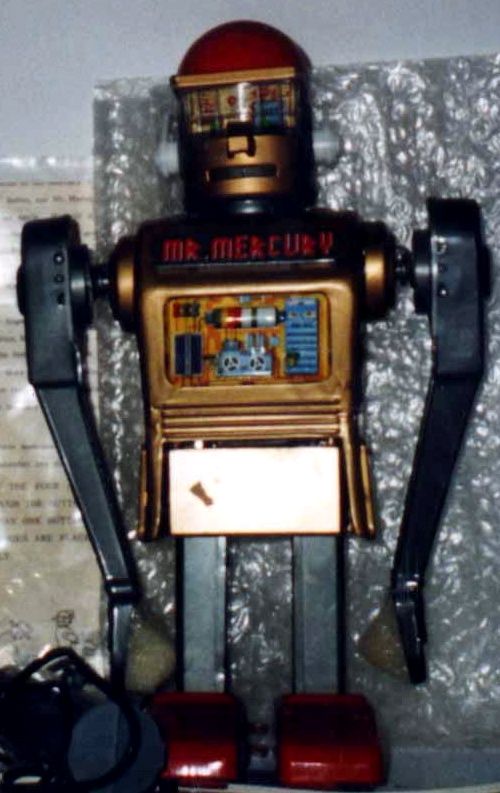
science-fiction toys my allowance could buy. Remote
controlled Mr.
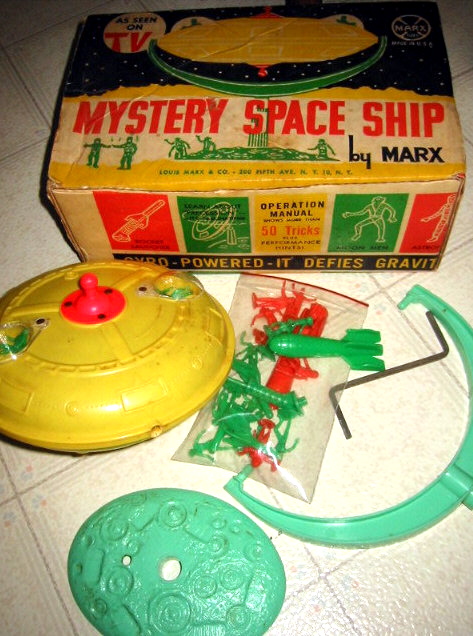
Mercury stood watch by Marx’s Mystery Space Ship, a yellow
plastic
gyroscope which could be cranked up to “hover” on its
platform or
balance
on a string. The Space Ranger Orbiting Space Ship, another
Marx
creation,
whipped around on a pole while the propeller-driven ship
swooped and
dove,
maneuvering to rescue tiny astronauts trapped on the lunar
surface.
L:
Mr.
Mercury. This gold version was for sale at a toy
show. R: Marx's
Mystery Space Ship was really a large gyro you wound
up with a crank.
It could balance on a string and do other
amazing feats.
|
Like
so
many
other junior astronauts of the era, every night I’d retreat
to my
bedroom and its science-fiction world of progress and peace.
But the
harmony, alas, was not to last, and my next act was one for
which robot
collectors may feel I should do penance. To my young mind,
the insides
of my robots seemed more fascinating than the outsides, and
I took them
apart. The parts found their way into the home-built robots
I daily
tried to construct, none of which matched the ingenuity of
the
originals.
The
few
tin
toys that remained in my collection survived because my mom
hid
them away. Even in those halcyon years when each new Sears
toy
catalog brought fresh worlds of enchantment, she sensed that
the days
of
the great robots were numbered. Over the years I have begun
collecting
robots again, but I will never forget what my “friend from
the moon,”
and the other metal and plastic inhabitants of that
science-fiction
wonderland meant to a nine year old kid growing up in the
space age.
© copyright Gord Wilson.